
 By Colin Foster
Updated November 2026
If you are looking for the best day hiking backpack for petite female hikers, the main problem is usually fit rather than capacity. Most packs are built around average torso lengths, so a small woman often ends up with shoulder straps that sit too low, a hipbelt that rides over the iliac crest, and a load that pulls backward on the trail. This guide compares three lightweight daypacks in the 10 to 20 liter range that suit smaller frames better than standard-size models. We judged them on stated capacity, weight, torso adjustability, load-carrying features and owner feedback patterns, not on personal testing.
Our Top Picks
Quick Comparison
| Product | Best for | Key feature |
|---|---|---|
| Seektop 15L Small Hiking Backpack for Women Men, Lightweight Hiking Daypack | Half-day hikes and all-round daypack use | Water-resistant shell with foldable, packable design |
| SKYSPER Small Daypack 10L Hiking Backpack Packable Lightweight Travel Day Pack for Women Men | Short trail walks and minimalist carry | Very low volume and packable construction |
| ECOHUB Small Hiking Backpack for Men Women, 20L Lightweight Travel Backpacks Water Resistant Camping Cycling Hiking Daypack | Longer day hikes needing more room | Largest capacity of the three at 20 liters |
Seektop 15L Small Hiking Backpack for Women Men, Lightweight Hiking Daypack

Seektop 15L Small Hiking Backpack for Women Men, Lightweight Hiking Daypack | Water Resistant, Foldable Packable Back Pack with Phone Pocket for Travel Camping Outdoor
This pack suits petite hikers who want a middle-ground capacity for day hikes with a layer, water, snacks and a phone. Its 15 liter volume is large enough for most three-to-six-hour outings without the bulk of a full-size daypack, and the compact footprint tends to sit closer to the back, which many smaller frames prefer.
Key specs
- Capacity: 15 liters
- Water-resistant outer fabric
- Foldable and packable design
- Dedicated phone pocket
Pros
- The 15 liter size balances room and a low profile for shorter-torso frames.
- The water-resistant fabric helps protect electronics during light rain.
- Folds down to stow easily in a car or a larger pack.
Cons
- Lightweight daypacks in this class usually offer limited hipbelt padding, so heavy loads can feel less stable.
- Owners who carry more than about 10 pounds often report the straps need adjusting to stay comfortable.
SKYSPER Small Daypack 10L Hiking Backpack Packable Lightweight Travel Day Pack for Women Men
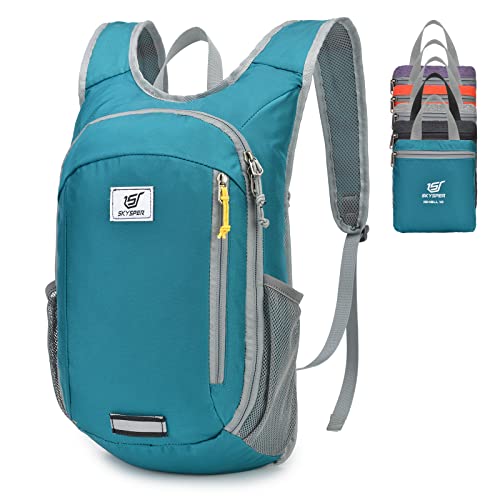
SKYSPER Small Daypack 10L Hiking Backpack Packable Lightweight Travel Day Pack for Women Men
This is the smallest of the three and fits petite hikers who carry very little: a light jacket, a water bottle, a small snack and keys. At 10 liters it avoids the excess length of larger packs, which is useful when the bag would otherwise hit the hips or sway at the lower back.
Key specs
- Capacity: 10 liters
- Lightweight, packable construction
- Designed for travel and day use
Pros
- Low volume keeps the pack from riding too far down the back on a short torso.
- Packable design makes it easy to carry as a backup bag.
- Light enough that the added weight of the pack itself is minimal.
Cons
- 10 liters is tight for anyone who needs extra layers, a first-aid kit and a full water supply.
- Owners report that the thin straps offer little support once the pack is near capacity.
ECOHUB Small Hiking Backpack for Men Women, 20L Lightweight Travel Backpacks Water Resistant Camping Cycling Hiking Daypack

ECOHUB Small Hiking Backpack for Men Women, 20L Lightweight Travel Backpacks Water Resistant Camping Cycling Hiking Daypack
This is the best fit for petite hikers who regularly go out for full days and need more room for water, food and layers. The 20 liter capacity is the largest of the three, so it suits longer outings, but it is still listed as a small hiking pack, which keeps it more manageable than a standard 30 liter daypack.
Key specs
- Capacity: 20 liters
- Water-resistant construction
- Designed for hiking, camping and cycling
Pros
- The 20 liter volume handles full-day loads without a large external footprint.
- Water-resistant fabric suits variable weather on longer trips.
- Versatile enough to double for cycling or camping outings.
Cons
- At 20 liters the pack is more likely to extend below the lower back on a petite frame, so check the torso fit carefully.
- Owners who pack heavily sometimes report that the shoulder straps sit wider than they would like on a narrow frame.
Buying Guide
Choosing the best day hiking backpack for petite female hikers starts with torso length, not with the number on the label. A pack that is too long will bounce, pull on the shoulders and push the hipbelt out of position. The guidance below will help you narrow the field before you compare individual models.
Selection Criteria
- Torso fit: Many petite-friendly packs use a shorter back panel and adjustable torso length. Measure from the bony bump at the base of your neck (C7 vertebra) to the top of your hip bones, and compare that number to the manufacturer’s torso range.
- Capacity: Match volume to trip length. Ten to twelve liters covers short walks, 15 liters handles most half-day hikes, and 20 liters suits longer days with more water and food.
- Weight: Lightweight daypacks typically weigh well under two pounds empty. Keep the pack’s own weight low, since every ounce adds up over miles.
- Weather protection: A water-resistant shell protects against light rain. For heavy rain or river crossings, a waterproof pack or a dry bag liner is safer.
Important Features
- Adjustable shoulder straps that let you lower or raise the load
- A hipbelt that sits on the hip bones rather than the waist
- Sternum strap to keep the straps from slipping outward
- Hydration bladder compatibility if you plan to drink on the move
- Side compression straps to keep the load close to the body
Specs to Check
Confirm the torso length range, capacity in liters, empty weight, and whether the hipbelt is padded. Manufacturers specify these numbers, and they are more reliable for comparison than marketing language. If a listing does not state torso range, assume the pack is built for an average frame.
Choosing by Need
- Short walks and light carry: Choose a 10 liter pack.
- Half-day hikes: Choose a 15 liter pack with a compact back panel.
- Full-day hikes with extra water: Choose a 20 liter pack, and test the torso fit before you buy.
Things to Watch Out For
- Packs marketed as “women’s” are not always cut for shorter torsos, so check the actual measurements.
- Very thin straps can dig in once the load exceeds about 10 pounds.
- Overpacking a small pack can stress the zippers and seams over time.
For guidance on fit, you can also read our Hiking Backpack with Frame: How to Choose the Right One (2026) and 4 Best Small Women's Hiking Backpacks for Day Trips in 2026.
FAQ
What size daypack is best for a petite woman?
For most petite hikers, 10 to 20 liters is the practical range. Smaller volumes suit short walks, while 15 to 20 liters covers longer days. The torso length of the pack matters more than the volume, so check that first.
How do I measure my torso length for a backpack?
Have someone measure from the bony bump at the base of your neck down to the top of your hip bones. Compare that figure to the torso range listed by the manufacturer. If you are between sizes, the adjustable models give more flexibility.
Is a hipbelt necessary on a day pack?
A hipbelt is most useful when the load exceeds about 10 pounds. Lightweight packs without a hipbelt are fine for light loads. If you add one, make sure it sits on the hip bones.
Should a petite woman choose a women’s-specific pack?
Women’s-specific packs often use narrower shoulder straps and shorter torsos, which can help. However, the label alone does not guarantee fit. Always compare the measurements to your body.
Can a small daypack handle a full day on the trail?
A 15 to 20 liter pack can handle a full day for many hikers, provided you pack efficiently. Carry water in a bottle or bladder, pack heavier items close to your back, and avoid bulky extras.
Are small hiking packs waterproof?
Most lightweight daypacks are water-resistant rather than fully waterproof. They shed light rain well but may let water through in heavy downpours. Use a rain cover or dry bag liner for wet conditions. For more detail, see Water Resistant Hiking Backpack: How to Choose One That Keeps Gear Dry.
Where can I find a lighter option for longer hikes?
If you are planning multi-day trips, a different category may suit you better. Read Best Backpack for Through Hiking: How to Choose the Right Pack for a Long Trail for guidance on larger packs.
Conclusion
The best day hiking backpack for petite female hikers depends on torso fit and how much you carry. The 10 liter SKYSPER suits minimal carry, the 15 liter Seektop fits most half-day hikes, and the 20 liter ECOHUB works for longer outings if the torso length matches your frame. Measure your torso before you buy, check the adjustability, and choose the volume that matches your typical trip. For a wider look at options, browse 7 Best Ladies Small Hiking Backpack Picks for Every Trip (2026).
About Colin Foster
Colin Foster is part of our editorial team and reviews and edits our backpacks & packing systems guides, checking product details against manufacturer specifications and owner feedback.



